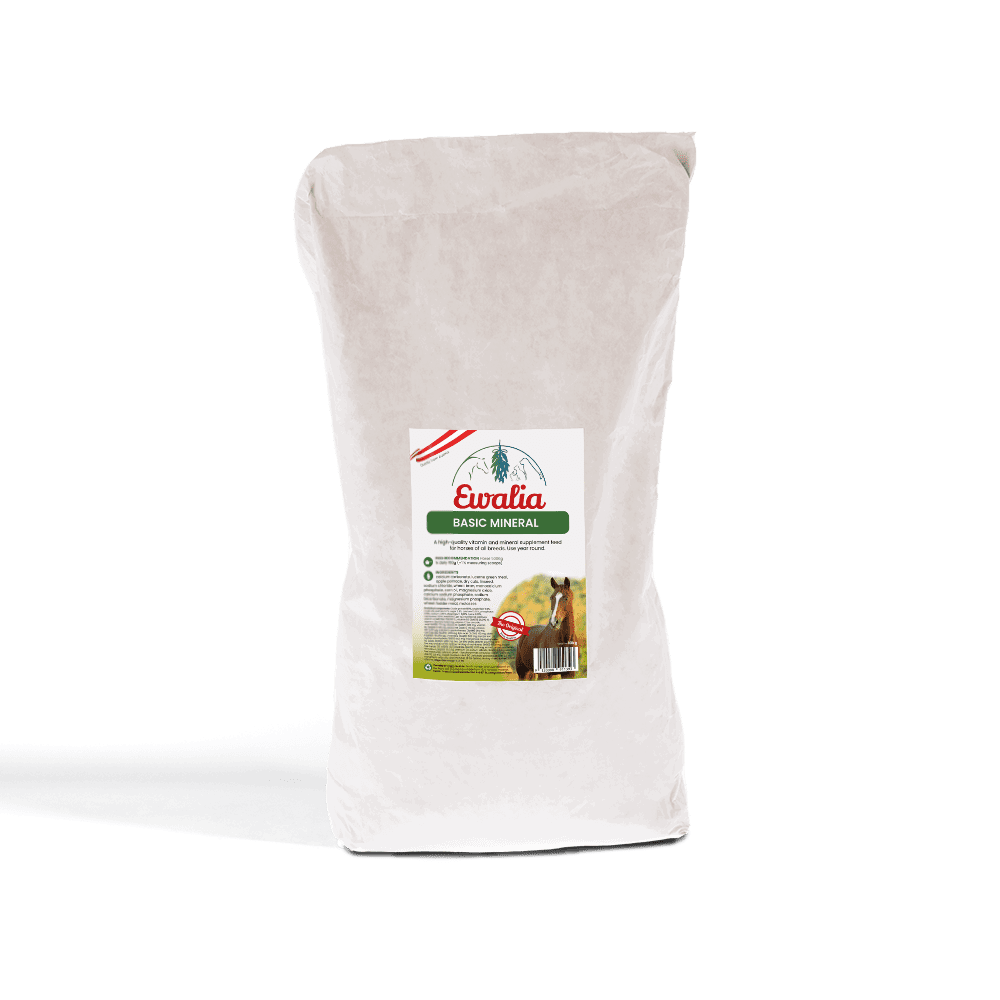


EWALIA Basic Mineral

A well-balanced mineral feed for horses – many of our customers have recently expressed this wish. Naturally, we got straight to work, analyzing hay analyses from Germany and Austria and developing a base mix that is ideal for the needs of many horses.
What is a mineral feed?
According to the definition in the European feed regulation, a complementary feed is considered a mineral feed if its crude ash value is above 40%. This does not mean that a mineral feed actually contains ash, but rather roughly indicates the value of the inorganic components of the feed, i.e. the minerals.
For horse owners, a mineral supplement feed is understood to be a feed offered in pelleted or powder form that contains all the minerals and vitamins a horse needs, in order to prevent or compensate for deficiencies caused by housing, feeding and performance. However, all mineral feeds are complementary feeds and do not cover the complete daily requirement of all necessary nutrients!
Why does my horse need a mineral feed?
One might think that roughage, as the basis of equine feeding, should in itself provide an adequate supply of minerals and vitamins. However, a closer look at the composition of soils and roughage increasingly reveals that, due to overuse, inadequate fertilization of the often very one-sided vegetation, and permanent overgrazing, some trace and macro elements are barely present or no longer present at all. It's not only the well-known selenium deficiency in soils and roughage that is an issue - Selenium deficiency in horses - but also a deficiency in iron, copper or other elements.
The need for mineral feed in horse nutrition is not only due to the inadequate content of the basic feed, but also to the performance demands and the often not species-appropriate housing of our horses. The modern sport horse, for example, has high performance demands and therefore a significantly increased need for various minerals. However, we don't keep our horses year-round on large, changing pastures with a wide variety of grasses, branches and herbs, but mostly in a stall or paddock box with some turnout on a small, permanently grazed area. Feeding mineral feed is therefore a necessity for almost all horses today. Additional stresses such as sport, breeding, growth, various illnesses, as well as the composition of the roughage, determine the amount and ratios of minerals and vitamins in the mineral feed.
What are minerals or mineral substances?
Minerals, or so-called macro and trace elements, are defined by their content and occur in nature in inorganic form. The macro elements such as calcium, phosphorus, magnesium, potassium, sodium, chloride and sulfur have already been extensively studied, and the data on ration recommendations is considered reliable. For the trace elements such as iron, zinc, manganese, selenium, copper, iodine, cobalt and chromium, there are long-standing recommendations, but not all trace elements have well-established knowledge regarding horses' requirements.
What is contained in EWALIA Basic Mineral?
The base mix contains all the trace and macro elements and vitamins needed for the maintenance requirements of an adult horse in light to moderate work. Additional needs, such as during pregnancy, lactation, high-performance sport, or underlying conditions like liver metabolism disorders or chronic small intestine inflammation, etc., are not accounted for in this mix.
Overview of the minerals contained, their function and properties:
Calcium (Ca)
- Bone mineralization
- cellular communication, signal transmission
- Blood clotting
- Cell metabolism
- CAUTION with heavy breeds or osteolytic spavin
Phosphorus (P)
- is a component of DNA
- Part of enzymes, proteins, phospholipids and phosphoproteins
- regulates the acid-base balance in cells and plasma
- necessary for microbial digestion
- increased requirement during stress, injuries and the lactation phase
Magnesium (Mg)
- responsible for the functions of numerous enzymes, primarily in nerve and muscle cells
- Bone mineralization
- Muscle movement
- activates enzymes and hormones
- a deficiency can lead to muscle tremors, muscle cramps or hardened muscles
Sodium (Na) and Chloride (Cl)
- are classified as electrolytes
- regulate osmotic pressure in body fluids
- high loss in a short time through sweating -> increased requirement
- maintaining an optimal acid-base status (pH value)
- Sodium influences thyroid function
- influences the regulatory hormone of drinking behavior (aldosterone)
Iron (Fe)
- Formation of the red blood pigment hemoglobin
- Formation of the red muscle pigment myoglobin
- Factor for enzymes
- increased requirement in foals, blood loss, heavy sweat loss and intensive training phases
- Hepcidin regulates iron absorption
- CAUTION with chronic small intestine inflammation -> iron deficiency possible
- CAUTION with chronic liver inflammation -> high iron levels
- high iron absorption disrupts the utilization/function of manganese, and presumably also copper and zinc
Copper (Cu)
- essential for the formation of nerve cells, blood, pigments and connective tissue
- Resilience of tendons and ligaments
- Involved in bone metabolism
- in hay and grass, presumably sufficient only for the maintenance requirement
- Increased requirement in foals and mares
- a deficiency can lead to anemia, pigment loss or vessel rupture
- severe copper deficiencies can manifest as zinc deficiency
- ideal ratio of copper to zinc in the total ration -> 4:1
Zinc (Zn)
- essential for enzymes of carbohydrate and protein metabolism
- Functions of the skin and mucous membranes
- necessary for the pancreas and liver
- Function of nervous tissue
- Cell renewal and preservation of genetic information
- Keratin formation
- cognitive performance
- Zinc content in roughage or green forage is not sufficient
- with a high supply of Ca and Cu, reduced zinc absorption is to be expected
- significant deficiencies are recognizable by thickened skin and hair loss
- CAUTION with high potassium intake, poor zinc absorption
Manganese (Mn)
- Co-factor in many enzyme systems
- Function of the ovaries
- Function of the immune system
- Protection against oxidative stress
- there is little scientifically established basis regarding manganese
- CAUTION high manganese levels inhibit iron absorption
Cobalt (Co)
- is a component of vitamin B12, which is produced in the horse's gut by microorganisms
- essential for energy metabolism
- little researched
- Cobalt deficiency leads to vitamin B12 deficiency
- manifests as anemia, skin changes or growth stagnation
Iodine (I)
- is a component of the thyroid hormone
- Relevant for growth
- Iodine supply is sufficient in coastal regions; in the Alpine region, iodine deficiency is possible
- Deficiency can lead to goiter formation, lethargy or hair loss
- impaired thyroid function can manifest through elevated estrogen levels -> strong estrus
- CAUTION avoid iodine deficiency or excess in pregnant mares -> risk of abortion or malformations possible
Selenium (Se)
- protects the cell membrane from peroxides, like vitamin E (colloquially: hydrogen peroxide)
- therefore a radical scavenger
- essential for the immune system
- a deficiency, or too little selenium in the daily ration, weakens infection defense
- CAUTION acute and chronic selenium poisoning possible with overdose
- Signs of selenium poisoning: sweating and colic in acute cases; in chronic selenium poisoning, ring-shaped constrictions, laminitis, and hair loss on the mane and tail
- organic selenium (selenium yeast) cannot be excreted (high probability of poisoning in case of overdose)
Vitamin A
- does not occur as vitamin A (retinol) in plant-based feeds
- present as a provitamin in carotenoids (β-carotene)
- Development and maintenance of vision
- antioxidant properties
- Storage in the liver
- Retinol has high absorption
- Carotenoids have low absorption
- Vitamin A deficiency: weakened immune system, brittle hoof material, up to visual disturbances
- Vitamin A excess: liver overload, itching, dry skin, ataxia, depression
Vitamin D
- Vitamin D2 (ergocalciferol) and vitamin D3 (cholecalciferol)
- Provitamins and UV light form vitamin D
- Supplementation may be necessary for horses wearing a rug 24/7
- Deficiency can result from lack of sunlight, roughage deficiency, liver diseases or skin diseases
- Reports on deficiency symptoms are lacking
- Excess: signs of poisoning, lameness, kidney failure, excessive bone growth
Vitamin E
- Tocopherols -> α-tocopherol has the greatest effectiveness
- Antioxidant and radical scavenger
- essential for cardiac and skeletal muscle tissue
- Seeds and grains have a high vitamin E content
- synthetic vitamin E is more resistant and stable
- Vitamin E deficiency: poor cell regeneration, increased need for proteins and trace elements, muscle stiffness, irritability, poor wound healing, muscle hardness
- high requirement in cases of laminitis
Vitamin C
- also known as ascorbic acid
- Cell protection as an antioxidant
- requirement disputed
- sufficient supply in healthy horses
- Deficiency possible due to stress or in old horses
- increases Fe absorption
Vitamin B1
- also called thiamine or aneurin
- important for carbohydrate metabolism
- Requirement increases with higher carbohydrate feeding, in high-performance horses, with high concentrate feed intake, or with moldy feed
- Vitamin B deficiency: skittishness and nervousness, lameness, lethargy and depression, tendency toward inflammation, susceptibility to allergies
Vitamin B2
- Also riboflavin
- important for energy metabolism
- supports the utilization of fatty acids and amino acids
- Deficiencies are rarely known but can lead to conjunctivitis, tearing, and light sensitivity
Vitamin B3
- Also called niacin/nicotinic acid
- present in all cells
- important for protein and carbohydrate metabolism
- Requirement not clearly determined
Vitamin B4
- Also referred to as choline
- important for liver activity and fat metabolism
- Lecithin in the form of choline could provide good support in EMS
Vitamin B5
- Also pantothenic acid
- important for the citric acid cycle -> formation of coenzyme A
- Deficiency could not be experimentally induced
Vitamin B6
- Also pyridoxine/pyridoxamine/pyridoxal
- important for amino acid metabolism
Vitamin B7
- Also known as biotin, vitamin H
- responsible for cell maturation and keratin formation
- targeted supplementation recommended for horses with poor hoof horn
Vitamin B9
- Also folic acid
- plays an important role in gonad function and embryonic development
- Supply is generally adequate (10x higher with pasture keeping)
- Vitamin B9 deficiency: reduced performance and anemia, but only observed in high-performance horses kept in stables without access to green fodder
Vitamin B12
- Also cobalamin
- important for cell division, i.e. for tissue with high cell turnover such as the intestine or nerves
- Mucous membrane production
- Cobalt in the feed necessary
- increased requirement in horses with gastric and intestinal inflammation
Calcium carbonate or feed lime (approx. 20g)
Powdered or granulated feed lime is a long-established calcium source made from calcium carbonate from Austria. This mineral feed is not suitable for horses that need a low-calcium diet.
Alfalfa meal (approx. 17g)
Green meals are meals made from dried green plants, in this case dried, ground alfalfa. Alfalfa, when flowering, looks confusingly similar to clover and likewise has an elevated amino acid (protein) content.
Apple pomace (approx. 10g)
Apple pomace is a by-product of fruit processing; it is low in protein and high in crude fiber. The pectin content of the pomace is very high, since pectin occurs mainly in the peel, but the sugar content is significantly lower than in whole apples. Most of an apple's sugar ends up in the pressed juice. For pressed mineral feed, apple pomace together with molasses works very well as a binding agent and somewhat masks the metallic taste of the ingredients.
Linseed, processed (approx. 9g)
Processed linseed means the seeds are crushed using pressure and temperature. The advantage is that the thermal treatment removes hydrocyanic acid. The fat content is significantly lower as a result of this treatment (under 10%).
Sodium chloride or livestock salt (approx. 4g)
Livestock salt is important both for electrolyte supply and as a flavoring and preserving component.
Wheat bran (approx. 10g)
Wheat bran mainly contains the outer layer of the wheat grain and only small amounts of the starchy endosperm. It serves as a phosphorus source and is generally readily eaten by horses.
Corn germ oil (approx. 1.8g)
Corn germ oil has a high proportion of unsaturated fatty acids and is also used in our mineral mixture as a carrier, binding, and mixing agent.
Wheat feed meal (approx. 1g)
Wheat feed meal is the so-called tailings flour from flour production, i.e. a by-product of grain processing. This tailings flour has a high starch content and would therefore be completely unsuitable as a standalone feed. In our mineral feed it serves to improve taste and as a natural binding agent.
Molasses (approx. 1.2g)
Molasses, or sugar beet syrup, is also a binding and lubricating agent in pellet production. Its proportion in our mineral feed is very small and necessary to reduce the pressing pressure during pellet production, since the pellets can be shaped better with a bit of molasses and oil.
L-carnitine (approx. 0.1g) as well as amino acids such as lysine (approx. 2.1g) and methionine (approx. 0.65g)
A small proportion of essential amino acids, which are indispensable for protein synthesis, i.e. the formation of protein, rounds off the Basic Mineral.
What makes EWALIA Basic Mineral special?
Basically, EWALIA Basic Mineral is a mixture that can already be found in similar forms on the market - we're that honest. Still, there are a few small special features:
- Our Basic Mineral contains NO hidden stevia - you can count on that!
- We have formulated the mixture with a significantly lower vitamin A content, since in our opinion it is clearly overdosed elsewhere, and hypervitaminosis could trigger severe itching or similar effects, or place a heavy strain on the liver.
- We keep the inorganic proportion of minerals higher and add only a small proportion of organic minerals. Although most organic compounds of minerals with amino acids result in better absorption in the horse's body, from a chemical standpoint an organic mineral is not natural but actively manufactured by humans. Chemically, the structure is therefore not natural for the organism and in some cases cannot be excreted during the metabolic process. Overdosing can lead to deposits.
- We deliberately do NOT add any herbs to the mineral feed. In our view, herbs should be used in a targeted way and not fed continuously and carelessly throughout the year.
- Our mineral feed contains a small proportion of molasses to increase the vitamin content after the pellets are pressed. Molasses reduces the pressing pressure and thus the temperature during production. In this small amount, it is barely relevant even for EMS horses. The proportion of starchy wheat feed meal is also very low and practically negligible. The sugar content is below 3%.
When can I feed EWALIA Basic Mineral?
Ewalia's mineral feed can be fed ...
- if your horse counts as "adult", i.e. from about 3 years of age.
- if your horse is generally healthy.
- if your horse receives forage low in selenium.
- if your horse does not receive any other feed containing minerals or vitamins.
- if your horse receives grain.
When should I NOT feed EWALIA Basic Mineral?
Ewalia's mineral feed should not be fed ...
- if your horse is very old, pregnant, lactating, or severely ill, the Basic Mineral is not an optimal fit and a deficiency could still occur.
- if your horse receives many other supplementary feeds containing minerals and vitamins
- and you have not calculated whether this results in an oversupply.
- if your horse is already oversupplied with selenium through its forage.
- if there is an intolerance or allergy to any ingredient.
- if balancing your forage shows that the composition of our mineral feed does not match your forage and your horse's requirements.
We recommend that you balance your forage and your horse's requirements, and choose a suitable mineral mixture based on these values. It's best to consult brand-independent feed advisors with an academic background, such as in agricultural science or veterinary medicine, and get professional help putting together rations for your horses. If you have any questions about our products, we're happy to help.
Sources
- Coenen, M., & Vervuert, I. (2020). Pferdefütterung (6th ed.). Stuttgart: Georg Theme Verlag KG.
- GfE, G. f. (1994). Empfehlungen zur Energie- und Nährstoffversorgung von Pferden. DLG-Verlag.
- Röhm, C. (2019). Nährstofflehre in der Pferdefütterung. Webinar. Unabhängige Fütterungsberatung Constanze Röhm.
Our products are not medicinal products. They are therefore not intended for the treatment of pathological conditions or associated symptoms. Feed products and care products are intended solely to support and care for your healthy horse. Your veterinarian or animal health practitioner is solely responsible for treating any illness or for other therapeutic recommendations.
Related products