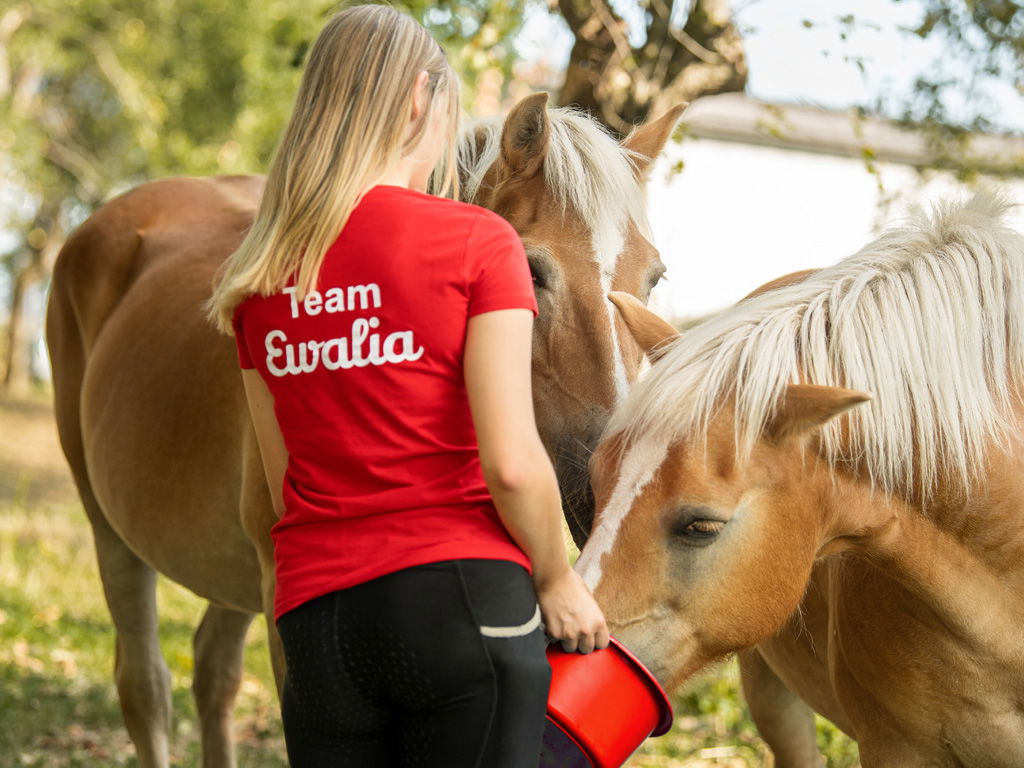


Turning horses out onto pasture correctly!


- for stable intestinal function
- for optimal digestive processes
- for a healthy intestinal flora
When is my horse allowed on pasture?
Traditionally, the grazing season begins at the start of May, or as it used to be said, “when the horse chestnut blooms.” Today, pasture gates are usually opened once the grass is 20 to 30 cm tall. At this growth stage, the grass is very lush, containing over 75% water. Due to the high leaf content, the young grasses have a protein content of up to 35 g per kilogram. What makes spring grass particularly palatable for horses is its sugar content: high-yield “performance grasses” contain around 23% sugar at the start of the grazing season. This means that horses eating 10 kg of grass would take in 2.3 kg of sugar – and the metabolism first has to cope with that!
Why do I even need to introduce my horse to pasture gradually?
Most horses spend the winter on paddocks or fields without grass cover. This serves to protect the pasture areas:
- Soft ground from rain or thawing would be damaged by movement.
- Trampling and running quickly lead to deep holes and a destroyed turf.
That's why continuous pasture turnout over winter is barely possible in our regions.
What do horses eat outside in winter?
If enough area is available, horses can still find the following on winter pastures:
- Leftover grass remnants from autumn
- Scrub, matted tufts of grass
- Leaves, branches and even tree bark
From February, the first green blades occasionally appear, and by March the grass slowly increases. This slow transition to pasture feed would be ideal for digestion. But reality often looks different.
Digestion in winter mode
In the cold season, we mainly feed fiber-rich hay and often additional concentrate feed.
These dry feeds need to be well chewed and mixed with saliva.
Saliva is important: It neutralizes the pH level in the digestive tract and protects the stomach.
Over the course of winter, digestion adapts to this feed.
The shock of the first turnout
In spring, the grass is lush, fresh – and gets eaten eagerly. Less saliva is produced in the process, which means the pH level in the stomach drops and the gut environment becomes unbalanced.
Possible consequences can include: abnormal fermentation, gas formation, colic, diarrhea or watery droppings


The protein problem in young grass
Healthy horses generally cope well with the surplus of protein in young grass. However, with a sudden excess of protein, the abrupt changes in gut flora can lead to digestive disturbances such as bloating, soft, foul-smelling droppings or diarrhea.
- Horse weighing 600 kg: 363 g pcvRp/day
- Horse weighing 300 kg: 216 g pcvRp/day
❗(pcvRp = praecaecal digestible crude protein – i.e. usable before the cecum)
Assuming that 1 kg of pasture grass in spring can contain up to 35 g of crude protein, and that feed intake can be 50 kg or more, this results in considerable surpluses that place a huge burden on the liver and kidneys! Excess protein produces harmful metabolic byproducts during digestion – hydrogen sulfide, ammonia and histamines – which the liver has to break down and the kidneys have to excrete. If the metabolism is already under strain, horses tend to develop swollen legs, eczema and allergies
Especially at risk are:
- Horses with liver or kidney weakness
- Animals prone to swollen legs, eczema or allergies
➡️ These horses should not be turned out on spring pasture!
Risk to gut flora from too rapid a transition
A horse's large intestine is a complex fermentation system:
- Populated by microorganisms that break down fiber-rich feed such as hay and straw
- They extract energy from cellulose and pectin in the form of volatile fatty acids
Problem: With a sudden switch to lush grass
➡️ Many of these bacteria die off
➡️ This has serious consequences for the metabolism
That's why:
A slow transition to pasture isn't optional – it's a necessity!
Conclusion
Why can young pasture grass trigger laminitis in horses?
It used to be thought that the high protein content of spring grass was the trigger for laminitis. As a result, pastures were mown short or affected horses were kept only on grazed-down areas.
Today we know:
👉 It's not the protein, but fructans – i.e. sugar storage compounds – that play the central role.
What exactly are fructans?
Fructans are water-soluble sugars that the plant stores when there's a surplus of energy, to use later for growth.
Their content varies greatly – depending on:
- Type of grass
- Weather conditions
- Temperature
- Time of day
Especially risky:
When it's sunny but at the same time too cold for plant growth, fructan is stored but not used up.
Typical in spring: Cold nights and sunny mornings. The plant only starts breaking down fructan around midday.
➡️ That's why old stable masters already warned against turning horses out onto pasture during morning frost – without knowing anything about the chemical background.
Why fructan can be problematic
Fructan itself is not toxic to horses.
Wild horses, for example, tolerate it without problems, because they eat lean, low-sugar steppe grass and their gut flora is fundamentally different to begin with.
For domestic horses, it's a different story:
- Energy-rich feed (silage, haylage, concentrate feed) allows more lactic acid bacteria to enter the digestive tract.
- If sugar-rich grasses with a high fructan content are then consumed, the number of these bacteria explodes.
The problem:
The horse's large intestine can't break down lactic acid.
➡️ This leads to over-acidification, the pH level drops, and healthy gut bacteria die off.
➡️ This releases endotoxins (toxic substances) that enter the bloodstream and can trigger severe inflammation, especially in the hoof.
Especially at risk are overweight horses and horses with metabolic conditions such as Cushing's or EMS.
Other risk factors for laminitis
Recent findings show that several stress factors must occur at the same time to trigger a laminitis episode. These include, for example:
- Endophytes – these are fungi that have been bred into certain grasses to make them more resilient. They can significantly increase the risk.
Atypical pasture myopathy – rare but life-threatening
A still little-researched, but usually fatal, condition is atypical pasture myopathy.
➡️ It occurs mainly in spring and autumn after frosty nights with high humidity.
➡️ It's presumably caused by a soil bacterium that then releases toxins.
➡️ Even horses turned out for just a few hours can be affected.


Preventing problems when turning out onto pasture!
When the grazing season finally begins in April or May, it's not just the horse owner who's happy – the horse itself often can hardly wait to finally eat fresh grass again. But a sudden start into lush greenery can lead to problems: gastrointestinal upset, diarrhea, laminitis, and metabolic derailment are possible consequences of what's known as “green feed shock.”
A good start as early as February or March
To prevent this strain, it's worth starting preparations as early as late winter. Already in February or March – of course only if ground conditions allow – horses can be led onto the meadow for a few minutes.
If the horse is eyeing the first green blades longingly, there's nothing wrong with letting it graze a little while being led by hand. These short “nibbling moments” help the digestive system to adjust to the upcoming change in feed early on.
This approach is definitely more sensible than overwhelming the horse with a sudden switch from hay to lush spring grass. Because especially at the start of the season, it's not uncommon for horses to take in more grass in just 30 minutes than in three hours on winter pasture!
Why gradual turnout is so important
Fresh pasture grass contains significantly more protein, sugar, and water than fiber-rich hay or sparse winter pasture. The digestive tract, gut flora, and the horse's entire metabolism first have to adapt slowly to these changed conditions.
A gentle turnout therefore protects not only the gastrointestinal tract, but also the liver, kidneys, and the whole body.
Challenges at boarding stables
The often-recommended method of increasing grazing time by ten minutes each day is hardly practical at larger boarding stables. If 30 horses are led onto the pasture one after another, the first would already have to go back before the last one is even out.
A good compromise: a small, not too lushly grown strip of green, fenced off with a mobile fence. This way, the group of horses can be gradually and controllably accustomed to fresh grass, without the logistics spiraling out of control.
Easy to implement for private horse owners
Private individuals often have it easier. Here, a structured plan is a good approach:
- Day 1: After letting the horse romp around, let it graze for 10 minutes – this helps burn off excess energy and guards against “feeding frenzies.”
- Time of day: Best in the afternoon, when the fructan content in the grass has already dropped.
- Increase: Grazing time can be extended by 10 minutes each day – always depending on the horse's individual digestive tolerance.
After four to six weeks: free pasture enjoyment
If this gradual buildup is carried out consistently, nothing stands in the way of full pasture use after about four to six weeks. Then the horses can enjoy the fresh grass – without health risks.
Safety first – even when leading out to pasture
An important note: don't let the horses onto too large an area at first. Even otherwise well-behaved animals can get overexcited during their first time on pasture – and can then be difficult to catch again. A small, enclosed area is much easier to control and reduces the risk of injury.
Don't forget to check the fences
Before the grazing season begins, it's worth thoroughly checking paddock and pasture fencing. Once horses have gotten a taste of pasture air, their motivation to gain access to fresh greenery increases – often using creative methods:
- testing electric fences,
- loosening or breaking wooden boards,
- digging under fences or even opening pasture gates.
An uncontrolled feeding frenzy can become dangerous – colic, laminitis, or diarrhea are common consequences.
Advantages of a grazing muzzle
A well-fitted muzzle can offer many advantages – both for the individual horse and for the whole herd:
- Longer turnout times are possible without feed intake getting out of control.
- Mixed groups don't need to be separated: "chunkier" horses and slimmer horses can graze together.
- Horses sensitive to metabolic issues can also take part in grazing – without health risks.
- No horse has to stand alone at the hay net, frustrated and pawing the ground.
Many horses get on well with a so-called grazing muzzle – especially if they were introduced to it early and gradually.
But: not every horse tolerates a muzzle well
For some horses, wearing a muzzle means considerable stress – despite every effort to get them used to it. Possible drawbacks:
- Limited social interaction such as mutual grooming or playful rank behavior.
- Disrupted communication – with facial expressions hidden, horses read each other less well.
- If dissatisfaction is high, the horse may become resigned or frustrated.
In such cases, it must be weighed up individually whether the psychological stress ends up causing more harm than the health benefit.
Take care when choosing a model
Not every muzzle fits equally well!
Models that resemble a "flowerpot with a hole" can easily slip.
- A poorly fitted muzzle can mean the horse can't eat at all.
- This leads to frustration, restlessness or even health problems.
👉 Tip: Check the fit of the muzzle regularly and observe how well your horse is coping with it – especially in the early stages.
It's not only too much young grass — stress out on pasture can also take a toll on a horse's stomach. The new, unfamiliar environment and a newly formed grazing group can significantly raise the horse's stress level. On top of that, rank fights and chasing carry a high risk of injury, even on large paddocks.
Very important!
Feed your horse enough hay before turnout so it doesn't rush hungrily into the young grass. Hay also acts as a buffer for the energy-rich pasture grass and keeps the pH level in the digestive system stable. If the horse suffers from watery droppings, bloating or diarrhea at the start of the grazing season, the problem can usually be well managed with extra portions of hay. The occurrence of watery droppings is normal to a certain extent when switching from dry hay to lush pasture grass.
However, if the horse's condition doesn't improve despite extra hay or persists for longer than six weeks, a vet should be consulted!
Caution!!
Be sure to keep an eye on your horse's weight! For overweight horses, up to 1/3 of the hay ration can be mixed with straw.
Concentrate feed, if fed at all, should only be given after turnout. Especially at the start of the grazing season, minerals should be supplemented, since young grass contains little calcium and magnesium.
How long can my horse stay on pasture after the transition period?
How long the grazing time should be in spring can't be set as a general rule – it depends on two factors:
1. The condition and growth of the pasture,
2. And the individual horse – especially its metabolism and grazing behavior.
A frequently cited study shows:
Horses learn very quickly how much time they'll have on pasture – and adjust their grazing behavior accordingly.
Horses with limited pasture access can eat four times as much grass in a single hour as horses with unlimited turnout do in four hours!
This means: less grazing time doesn't automatically mean less grass intake.
👉 Conclusion: It takes a good eye, experience and a feel for your own horse to decide when and for how long grazing time can be extended.
Why pasture turnout is still so valuable
Despite all the challenges of the transition to pasture:
Pasture is one of the most natural and healthiest environments for a horse.
- Constant, gentle movement while grazing supports the musculoskeletal system.
- Continuous feed intake is ideal for a horse's sensitive stomach.
- Many horses with tendon issues or gastric ulcers show surprisingly quick improvement on pasture.
- Stress relief through nature and social contact – many horses find inner calm again out on pasture.


Supporting your horse's digestion during the transition to pasture!
Due to the change in feed and possibly pasture-related stress, a horse's digestive system is placed under considerable strain. Herbs can offer valuable support to horses during the transition to pasture. They can help stabilize digestion, ease the load on metabolism and help support overall comfort during the feed transition.
Contains mucilage that can have a soothing, protective effect on an irritated stomach lining and may help support stomach comfort.
Known for its soothing properties and may help support the stomach during the transition to pasture.
Supports gastrointestinal motility, may help with occasional bloating and supports overall digestion.
Its bitter compounds may help stimulate saliva and gastric acid production and support a healthy microbial balance in the digestive tract.
Contains tannins that can have a regulating, binding effect on the gut, which may be helpful during phases of loose droppings.
Binds fluid in the large intestine, slows the passage of droppings and can therefore be supportive during phases of loose droppings on pasture.
Supports a stable gut flora and the natural function of the digestive system.
May help stimulate kidney activity, increase urine output and support the body's natural detoxification processes during the feed transition.
May help support liver cell health and the liver's natural ability to cope with the effects of the feed transition.
Rich in mucilage and may help support a stressed stomach lining.
Conclusion

Frequently Asked Questions💡
For problems/complaints: 👉 Here we recommend the cure with 6 liters
We recommend feeding the increased amount (3 times the daily dose) at the start. Stay on the high dosage until an improvement occurs, plus 2 more days. After that, feed 2 times the normal amount. If the improvement continues, feed the remaining bottles at the normal dosage. How much needs to be fed always depends on the individual problem, i.e. whether improvement occurs faster or not.
For prevention: 👉 Here we recommend the cure with 3 liters
To help prevent problems and support general well-being: preventively, meaning no increased amount, just the normal amount over at least three weeks.
Not sure if your horse will eat our products? No problem! We offer our EWALIA Eating Guarantee.
If your horse doesn't accept our products, we'll refund you the full purchase price. How does it work and what do you need to keep in mind? Simply send the products back to us within 30 days of purchase and fill out our form with the details of your order, a short, uncut video of your horse, and the proof of purchase.
If you bought your EWALIA products from a retailer, contact the retailer directly within 30 days of purchase with your proof of purchase and video. They will refund the purchase price immediately. The Eating Guarantee can be used once per customer on products ordered for the first time. The guarantee applies to up to two different products per order.
You can find more information about our Eating Guarantee here in our terms and conditions: Eating Guarantee.
1. Better absorption and availability
Herbal liquids contain the active ingredients in dissolved form, which makes absorption in the body easier.They are often better tolerated, especially by animals with sensitive digestion or poor chewing ability (e.g. old horses or dogs).
2. Higher bioavailability
Thanks to their liquid form, nutrients and secondary plant compounds are absorbed into the blood more quickly, so they take effect faster.Dried herbs first have to be broken down in the digestive tract, which takes longer.
3. No dust exposure
Dried herbs can be dusty, which can be problematic especially for sensitive airways (e.g. horses with COB or dogs with allergies).Herbal liquids are dust-free and therefore also suitable for animals with respiratory conditions.
4. Easier dosing & feeding
Herbal liquids are easier to mix into feed or give directly into the mouth.Especially with picky animals, the liquid form can be advantageous, as acceptance is often higher than with bitter-tasting, dried herbs.
5. No burden from inferior feed quality
Some dried herbs lose their active compounds due to improper storage or contain fungi, mold, or contaminants.High-quality herbal liquids are freshly pressed and gently processed, so the ingredients are largely preserved.
We recommend feeding our product twice daily. This ensures that the body can optimally absorb the valuable herbal active ingredients. One option is to prepare the feed the evening before for the morning feeding, e.g. by the stable staff, as long as it is given within 24 hours (especially important in summer). Alternatively, one portion can be given before and one after the riding session.
If feeding twice is not possible, we recommend giving 80% of the total daily dose to achieve the desired effect. For example, this would be 112 ml once daily for a total daily dose of 140 ml (70 ml + 70 ml). Our experience shows that regular twice-daily feeding is the best option to make full use of the effectiveness of our products.
You can find all further questions in our 👉 FAQS
Our products serve as a supportive measure in the form of complementary feed and do not replace veterinary examinations.
Yes, up to 3 liquids can be fed at the same time.