







Colic and Season (Oestrus) – Is There a Connection?

- ideal for mares in transition periods
- with harmonising chasteberry
- supports the regulation of hormone balance
Digestive System of the Horse
The horse's digestive system is a highly complex system. Hard-to-digest feed components can be converted very efficiently into digestible substances by the horse, as a herbivore. This happens in a very long gastrointestinal tract that can be up to 30 meters long. Millions of gut bacteria are highly effective helpers in this process. The primitive horse needed this kind of specialized digestive system. It lived on sparse, low-energy steppe grass. Large amounts of this grass had to be consumed to meet the horse's needs. Today the horse's feed ration consists of high-quality, energy-rich feed components. The functions and bacteria of the gut are not used in the original way.
👉 This results in an increased susceptibility to colic = abdominal pain in horses.
The digestive system is not influenced by diet alone. Heart and circulatory problems lead to poor blood flow to the gastrointestinal tract. This in turn leads to reduced gut motility and carries the risk of impaction colic. Stress, gastric ulcers, and gastrointestinal tumors are other possible causes of colic.
What causes mud fever and mallenders?
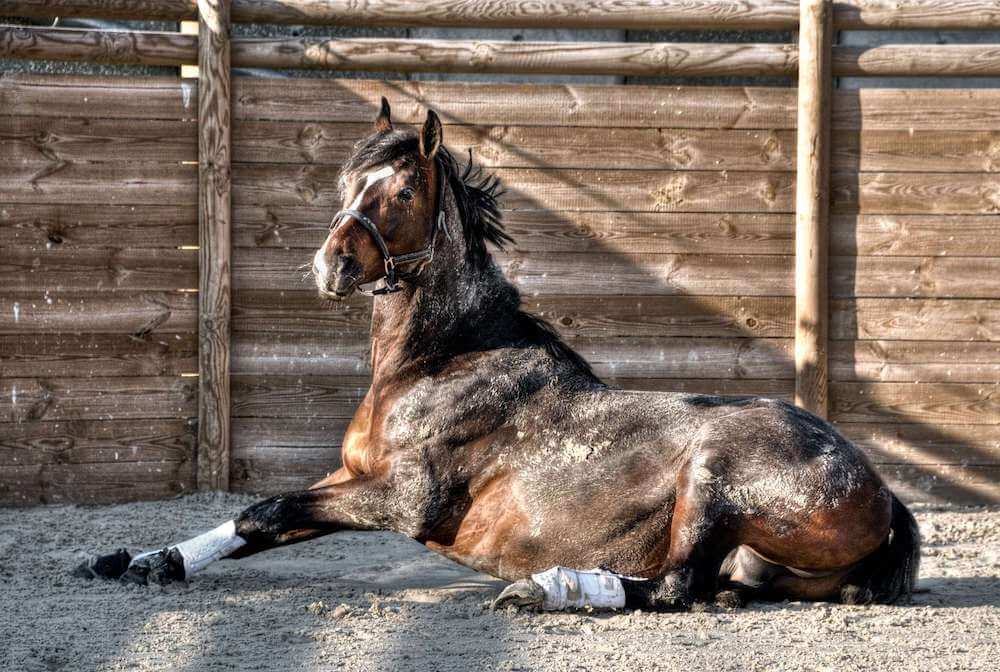
Some mare owners are familiar with the problem of colic when their mare is in heat. During this time too, mild colic symptoms can occur regularly. Over the course of the cycle, particularly at the mare's ovary, changes occur in a certain chronological sequence.
If all examinations for the following triggers come back without findings, the mare can be given an artificial hormone, a progesterone, over a certain period. This suppresses heat. If the colic issue resolves as a result, a connection between cycle activity and colic behavior can definitely be established.
Colic Triggers
In horses, the peritoneum covers the ovary. When a follicle matures and reaches an extreme size, it causes strong tension in the peritoneum over the ovary. In individual cases, this leads to increased sensitivity and also to colic symptoms.
Hematomas (bruises) or abscesses can also occur on the ovary and may be accompanied by colic-like behavior.
Changes in the uterus in horses are generally not associated with colic-like behavior. While problems in the digestive tract, such as stomach or intestinal disorders, often lead to colic, uterine changes in mares usually show up through other symptoms. These can include, for example, irregular or altered estrus cycles, vaginal discharge, or reduced fertility.
Tumors can also develop on the ovary. Various types of tumors on the mare's ovary can be associated with colic-like behavior. A tumor can cause pulling on the ovarian suspension or simply obstruct intestinal peristalsis due to its size.
Conclusion
Colic symptoms in mares can occur in connection with heat. During the cycle, especially in the follicular phase, hormonal changes and the growth of follicles on the ovary can cause discomfort. In rare cases, tumors or extreme follicle maturation can also trigger colic-like behavior. An examination by the veterinarian and, if necessary, the administration of progesterone can help confirm the connection between the cycle and colic and help manage the symptoms.
How Can I Prevent Colic?
Colic is a condition whose cause is often very difficult to determine. A species-appropriate housing and diet is very important.
Feeding:
🌱 Frequent feedings combined with an adequate amount of crude fiber are an essential requirement for a healthy horse.Water balance:
💧 Water is very important for the horse, as it is for other living beings. In summer on the pasture or, even more importantly, at a show in a truck or trailer the horse needs large amounts of water. Too little water leads to strain on the heart and circulation and to the drying out of the gastrointestinal contents.Exercise:
🐎 In addition to a species-appropriate diet, every horse should get enough exercise every day. Exercise stimulates the gut functions.Teeth:
🦷 Also not to be forgotten is a regular dental check-up every six to twelve months. If the teeth are not in good condition, horses do not chew their feed small enough and the risk of colic increases.

Frequently Asked Questions💡
For problems/complaints: 👉 Here we recommend the course with 6 liters
At the start, we recommend feeding the increased amount (3 times the daily dose). Stay on the high dosage until an improvement occurs, plus 2 more days. Then feed 2 times the normal amount. If the improvement continues, feed the remaining bottles at the normal dosage. How much needs to be fed always depends on the individual problem, i.e. whether improvement occurs faster or not.
For prevention: 👉 Here we recommend the course with 3 liters
To prevent problems and support general well-being: preventively, meaning no increased amount, just the normal amount for at least three weeks.
1. Better absorption and availability
Herbal Liquids contain the active ingredients in dissolved form, which makes absorption in the body easier. This is especially beneficial for animals with sensitive digestion or poor chewing ability (e.g. older horses or dogs), as they are often better tolerated.
2. Higher bioavailability
Thanks to their liquid form, nutrients and secondary plant compounds are absorbed into the bloodstream more quickly, so they take effect faster. Dried herbs first have to be broken down in the digestive tract, which takes longer.
3. No dust exposure
Dried herbs can be dusty, which can be problematic especially for sensitive airways (e.g. horses with equine asthma (COPD/RAO) or dogs with allergies). Herbal Liquids are dust-free and therefore also suitable for animals with respiratory conditions.
4. Easier dosing & feeding
Herbal Liquids can be mixed into feed more easily or given directly into the mouth. Especially with picky animals, the liquid form can be advantageous, as acceptance is often higher than with bitter-tasting dried herbs.
5. No burden from low-quality feed
Some dried herbs lose their active compounds due to improper storage or contain fungi, mold, or contaminants. High-quality Herbal Liquids are freshly pressed and gently processed, so the ingredients are largely preserved.
Yes, up to 3 Liquids can be fed at the same time.
We recommend giving our product twice daily. This ensures that the organism can optimally absorb the valuable herbal active ingredients. One option is to prepare the feed the evening before for the morning administration by the stable staff etc., as long as it is given within 24 hours (especially important in summer). Alternatively, one portion can be fed before and one after the riding session.
If twice-daily administration is not possible, we recommend giving 80% of the total daily dose to achieve the desired effect. For example, that would be 112 ml once daily for a total daily dose of 140 ml (70 ml + 70 ml). Our experience shows that regular twice-daily administration is the best option to fully utilize the effectiveness of our products.
You can find all further questions in our 👉 FAQS
Our products serve as a supportive measure in the form of complementary feed and do not replace veterinary examinations.
Not sure if your horse will eat our products? No problem! We offer you our EWALIA Eating Guarantee.
If your horse doesn't accept our products, you'll get the full purchase price back from us. How does it work and what do you need to keep in mind? Simply send the products back to us within 30 days of purchase and fill out our form with the details of your order, a short, uncut video of your horse, and the proof of purchase.
If you bought your EWALIA products from a retailer, contact the retailer directly within 30 days of purchase with your proof of purchase and video. They will refund the purchase price to you immediately. The Eating Guarantee can be used once per customer on products ordered for the first time. The guarantee applies to up to two different products per order.
You can find more information about our Eating Guarantee here in our terms and conditions: Eating Guarantee.