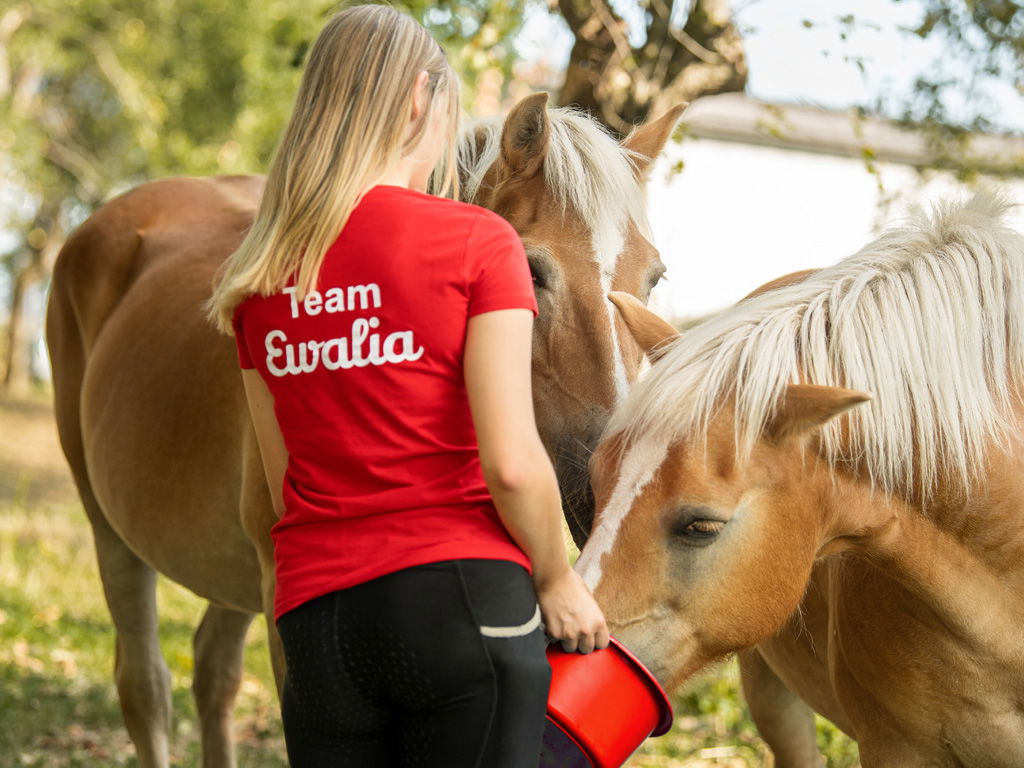


Mauke beim Pferd
During persistent damp weather in autumn, horse owners often have to deal with equine mud fever (Mauke). This stubborn skin inflammation, which begins with redness, nodules, pustules and crusts in the horse's pastern , can also spread to the inside of the cannon bones and is then called "Raspe" . Muddy winter turnout favors Mauke syndrome, but the causes of Mauke are varied. Which factors play a role here and what options you have to successfully treat your horse's Mauke symptoms, you can read here.


- with the power of milk thistle
- supports natural metabolic function
- with stimulating detox herbs
What is mud fever?
Mauke, or more precisely the "Mauke syndrome", is the collective term for a range of inflammatory skin changes that originate in the horse's pastern. Mauke typically occurs more frequently in autumn and spring – seasons in which the horse's organism is stressed by the change of coat.
Raspe (the precursor to Mauke) and Mauke begin with redness and itching in the pastern. Later, blisters, scabby crusts or a greasy discharge form. Without treatment, this leads to hair loss, cracks and inflammation that can extend up to the cannon bone .
Mauke: From first signs to chronic disease
Mild form:
- This is the most common form and shows up as hair loss, dry flaking and the beginning of crust formation. The skin in the pastern is reddened, itchy or painful. At this early stage, the eczema can still be managed well.
Exudative form:
- In this form, the inflammation has already spread to the sebaceous glands and hair follicles. Fluid-filled blisters form, which burst and crust over. The damaged skin becomes susceptible to bacterial secondary infections, which lead to pus formation . In the worst case, the rare "Brandmauke" occurs, in which sections of skin become necrotic and slough off or decompose into a greasy mass.
Verrucous Mauke:
- Severe cases can progress into verrucous Mauke. It is characterized by a massive thickening of the deeper skin layer (dermis), which initially appears as calluses and skin folds . The skin cracks and crusts over. The excessive granulation tissue forms grape-like growths and can spread across the entire cannon bone area.
What causes mud fever and scratches?
Not too long ago, mud fever was considered a purely hygiene-related problem and a sign of poor care. Many a responsible horse owner couldn't explain why the eczema appeared despite giving their beloved horse the best possible care, when the neighbor's horse spent hours wading through the muddy paddock and remained free of mud fever. Today mud fever is considered a multifactorial disease, meaning the eczema cannot be attributed to a single specific cause. Rather, several contributing factors are responsible for the occurrence of mud fever.
Mud fever is favoured by:
- Even though the skin needs moisture, prolonged contact with water can lead to a wide range of skin conditions. Extended dampness impairs the lipid layer of the skin, which forms a barrier against environmental irritants. The outermost layer of skin likely becomes more permeable.
- In addition, a humid climate leads to an increase in the skin's pH value. When the skin barrier is disrupted, repair processes occur at low pH values, but these are hindered under alkaline conditions.
- Pastern eczema can therefore develop not only in muddy paddocks or from damp bedding, but also on dew-wet pastures that dry late or not at all.
Bacterial mud fever develops from an inflammation that is initially limited to the hair follicles and spreads from there. The skin lesions appear as small nodules, which are usually only noticeable as tufted-up hair. At this stage, the hairs may already be stuck together by pus and small crusts. Mainly two types of bacteria are held responsible for these inflammatory processes: Staphylococci and Dermatophilus congolensis
- Staphylococci: They colonize the healthy skin and mucous membrane flora and can, under certain circumstances, become pathogenic organisms. In horses, skin injuries or mechanically stressed skin areas serve as entry points. What makes treating a staphylococcal infection difficult is the resistance of some strains to antimicrobial agents.
- Dermatophilus congolensis: Transmission occurs through direct or indirect contact with infected animals and objects. In horses, transmission via shared grooming, saddle, and bridle equipment plays a particularly important role, since hairs contaminated with bacterial spores can remain infectious for months to years. The bacteria penetrate the skin layer through small skin cracks, such as those caused by moisture or insect bites, and multiply anaerobically. Ticks can also transmit D. congolensis. Animals infested with ticks show more severe mud fever symptoms, which tend to become chronic. The reason is likely that tick infestation leads to a reduced immune response in the organism.
These surface-dwelling chewing mites are between 0.3 and 0.5 mm in size and feed on skin cells, sebum, and exudate. Mites of the genus Chorioptes equi preferentially infest horse breeds with heavy feathering on the fetlocks, as they thrive particularly well in warm, humid environments. The mites, which are transmitted through direct and indirect contact, trigger an immediate-type hypersensitivity reaction. This results in intense itching, and affected horses frequently stamp their feet. Typical signs include eczema with scaling and crusting, later hyperkeratosis and skin folds with a greasy, oily coating in the pastern area of the hind legs; the front legs are affected less often.
Minor injuries in the pastern area, such as skin lesions from thistles, grain stubble, or itchy insect bites, as well as skin irritation from sharp-edged sand used as paddock or riding arena footing, can lead to mud fever.


Mauke - Immunbedingte Ursachen
Vasculitis
- This refers to an inflammation of arteries, veins, or capillaries that occurs as a secondary effect of various diseases. Skin vascular inflammation is often linked to immunological processes
- Due to a hypersensitivity reaction, triggered by bacteria, viruses, or fungi, among other things, but also by medications, immune complexes form and are deposited, contributing to the destruction of the blood vessels. The skin reacts with redness, discharge, and crust formation. Edema often forms on the affected limb.
Allergic Contact Dermatitis
- Triggered by the combination of an allergen with the body's own proteins. A typical feature is that only individual animals show allergic reactions, e.g. to pasture plants or bedding, in the form of mud fever symptoms.
Irritant Contact Dermatitis
- The skin inflammation is caused by direct and prolonged contact with skin-irritating substances, including feces and urine, topically applied medications, or plants such as nettles. The symptoms of irritant contact dermatitis are similar to those of allergic contact dermatitis and present as redness, edema, and papules.
Photosensitization
- Mud fever can also result from photodynamic substances that the horse either comes into direct contact with or ingests via the digestive tract, from where they reach the skin through the vascular system. In combination with absorbed UV radiation, this subsequently leads to skin reactions, especially in poorly pigmented or white, thinly haired skin areas.
- St. John's Wort is often cited as a theoretical trigger – in practice, however, this effect of the plant has not been proven, since the horse would have to ingest a very high dose for a reaction to occur. Medications can also promote photosensitization.
- Photosensitization through direct contact has most commonly been reported in horses kept on pastures with a lot of alsike clover (Trifolium hybridum).
Fazit
Mud fever and scratches develop from a variety of causes. Moisture, skin irritation, bacteria, mites, and allergies are the main factors. UV radiation and certain plants can also increase the risk. So it is usually a combination of several influences that trigger the skin problems.
Is my horse prone to mud fever?
Horse breeds with heavy feathering, such as Tinkers, draft horses, and some pony breeds, suffer more often from mud fever and scratches. Genetic factors are also thought to play a role in susceptibility to mud fever. It has been shown that the skin of horses affected by mud fever has a barrier defect similar to that found in dogs with atopic dermatitis.
Horses with white pasterns are far more often affected by mud fever. This may be because the more strongly absorbed UV radiation affects the barrier function of the epidermis.
Mud fever also occurs more often on the hind legs. One explanation for this is the flatter angle of the pastern bone, which comes closer to the ground when the hoof lands and thus comes into increased contact with feces, urine, and mud.
What can I do about mud fever?
Measures against mud fever
Preventing and treating mud fever in horses requires careful care and maintaining clean and dry environments. The pastern should be cleaned regularly, gently removing any dried-on dirt. However, it's important to note that excessive washing of the skin can be harmful. In horses with heavy feathering, the hair should be carefully clipped or trimmed with scissors without injuring the skin. The cleanliness of the stall or barn is also crucial, and it should be cleaned regularly to minimize the moisture and dirt that could promote the occurrence of mud fever.
When switching from hay to pasture grass in spring, the horse's metabolism is often overloaded by the excessive protein intake. But at the beginning of the winter season too, the metabolism is heavily strained by the influx of almost unavoidable contaminants in hay. The detoxifying organs, liver and kidneys, are placed under great strain by these immense demands, and some of the breakdown products must be excreted through the skin. Targeted support of the detoxifying organs with herbs such as milk thistle, nettle, and dandelion can help support the skin against inflammatory conditions and mud fever that has already appeared.
With a strong immune system, the horse is well-equipped against stress from environmental factors. The immune system can be optimally supported with herbs such as echinacea, Siberian ginseng, or ginseng, and the vitamins found in rosehip.
For the effective treatment of mud fever, cortisone-based ointments act quickly against itching and pain, but they weaken the skin's defenses. A natural ointment offers a more lasting improvement. Chamomile extracts soothe irritated skin, grape seed oil provides essential fatty acids to strengthen the skin barrier, zinc supports the skin's natural renewal, and beeswax with vitamin A supports cell regeneration. Nevertheless, caution is advised – apply thinly, as mud fever needs air.
When switching from hay to pasture grass in spring, the horse's metabolism is often overloaded by the excessive protein intake. But at the beginning of the winter season too, the metabolism is heavily strained by the influx of almost unavoidable contaminants in hay. The detoxifying organs, liver and kidneys, are placed under great strain by these immense demands, and some of the breakdown products must be excreted through the skin. Targeted support of the detoxifying organs with herbs such as milk thistle, nettle, and dandelion can help support the skin against inflammatory conditions and mud fever that has already appeared.


Häufige Fragen💡
For problems/complaints: 👉 Here we recommend the course with 6 liters
At the beginning, we recommend feeding the increased amount (3 times the daily dose). Stay on the high dosage until an improvement occurs, plus 2 days. After that, feed 2 times the normal amount. If the improvement continues, feed the remaining bottles at the normal dosage. How much needs to be fed always depends on the individual problem, i.e. whether improvement occurs faster or not.
For prevention: 👉 Here we recommend the course with 3 liters
To help prevent problems and support general well-being: preventively, meaning no increased amount, just the normal amount for at least three weeks.
1. Better absorption and availability
Herbal liquids contain the active ingredients in dissolved form, which makes absorption in the body easier.They are often better tolerated, especially in animals with sensitive digestion or poor chewing ability (e.g. old horses or dogs).
2. Higher bioavailability
Thanks to the liquid form, nutrients and secondary plant compounds are absorbed into the blood more quickly, so they take effect faster.Dried herbs must first be broken down in the digestive tract, which takes longer.
3. No dust exposure
Dried herbs can produce dust, which can be problematic especially for sensitive airways (e.g. horses with COPD or dogs with allergies).Herbal liquids are dust-free and therefore also suitable for animals with respiratory conditions.
4. Easier dosing & feeding
Herbal liquids are easier to mix into feed or give directly into the mouth.Especially with picky animals, the liquid form can be advantageous, as acceptance is often higher than with bitter-tasting, dried herbs.
5. No burden from poor feed quality
Some dried herbs lose their active ingredients due to improper storage or contain fungi, mold, or contaminants.High-quality herbal liquids are freshly pressed and gently processed, so the ingredients are largely preserved.
Yes, up to 3 liquids can be fed at the same time.
We recommend giving our product twice daily. This ensures that the body can optimally absorb the valuable herbal active ingredients. One option is to prepare the feed the evening before for the morning feeding by the stable staff, etc., as long as it is given within 24 hours (especially important in summer). Alternatively, one portion can be fed before and one after the riding session.
If twice-daily feeding isn't possible, we recommend giving 80% of the total daily dose to achieve the desired effect. For example, that would be 112 ml once daily for a total daily dose of 140 ml (70 ml + 70 ml). Our experience shows that regular twice-daily feeding is the best option to fully utilize the effectiveness of our products.
You can find all further questions in our 👉 FAQS
Our products serve as a supportive measure in the form of complementary feed and do not replace veterinary examinations.
Not sure if your horse will eat our products? No problem! We offer you our EWALIA Feeding Guarantee.
If your horse doesn't accept our products, we'll refund the full purchase price.How does it work and what do you need to do?Simply send the products back to us within 30 days of purchase and fill out our form with the details of your order, a short, unedited video of your horse, and the proof of purchase.
If you purchased your EWALIA products from a retailer, contact the retailer directly within 30 days of purchase with your proof of purchase and video. They will refund the purchase price immediately.The Feeding Guarantee can be used once per customer on products ordered for the first time.The guarantee applies to up to two different products per order.
You can find more information about our Feeding Guarantee here in our terms and conditions: Feeding Guarantee.