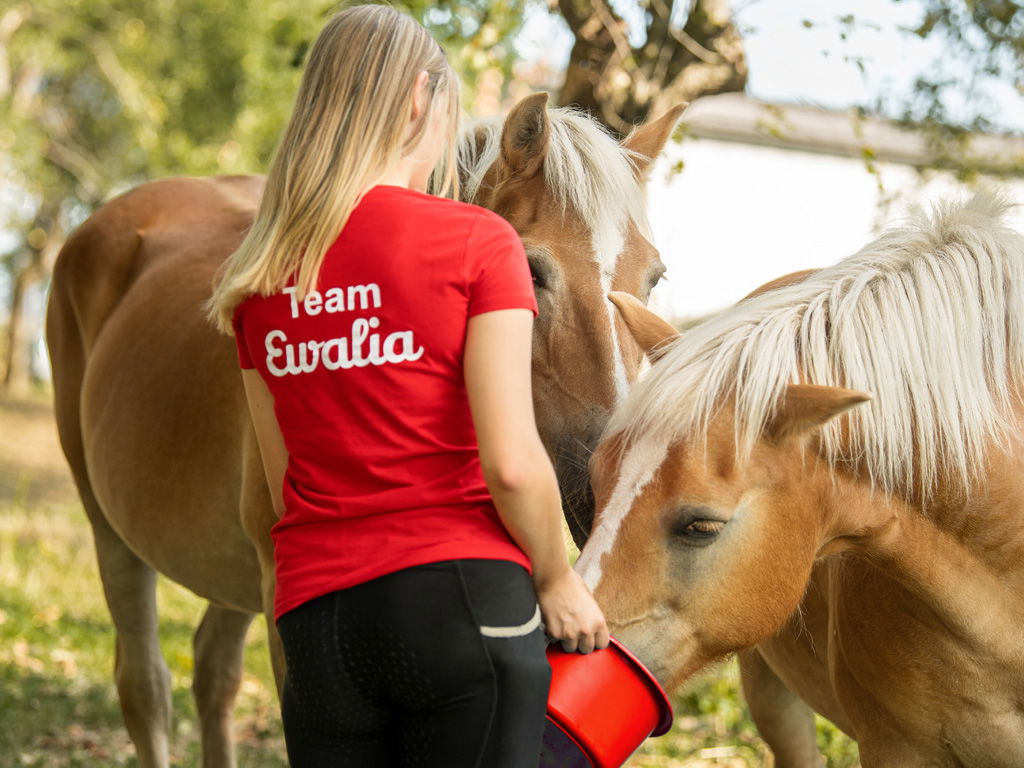


Liver and kidneys are heavily burdened during the coat change!


- with the power of milk thistle
- supports natural metabolic function
- with stimulating detox herbs
How can I recognize an overload of the liver and kidneys?
The blood test is often used as a check of the horse's bodily function. As a horse owner, it's tempting to feel reassured by this result when neither liver nor kidney values are elevated, but this could have fatal consequences. In the blood, liver and/or kidney problems only become visible once severe damage is already present, and it is often already too late. There are many small warning signs that we as horse owners should watch for more closely in our beloved companion.
🆘Possible warning signs of liver and kidney overload:
- Dull coat, especially when the hair "hooks" at the ends
- Poor or slowed coat change, poor winter coat
- Skin problems such as eczema, mud fever, mallenders/sallenders; tendency to phlegmon; hives; hypersensitivity to insect bites, grooming products, etc.; general itching; warts and sarcoids; tendency to fungus, chewing lice and other ectoparasites; general skin hypersensitivity.
- Hoof problems, such as hoof rot, hoof abscesses, thrush
- Edema, e.g.: swollen legs, "rest-day phlegmon"; spongy hock or carpal joints; swollen, firm crest; edema pads on the flanks, often mistaken for fat pads
- Allergies
- Poor wound healing
- Atypical sweating behavior, such as excessive or insufficient sweating
- Hyperventilation due to insufficient sweating
- Excessive or insufficient drinking, too much or too little urine
- Greedy eating of salt or mineral licks


What are the possible secondary diseases when the metabolism derails?
If early symptoms are ignored, metabolic problems can manifest as serious diseases.
Diseases in which metabolism and feeding play a major role include:
- Equine Cushing's Syndrome
- Equine Metabolic Syndrome ("diabetes", usually associated with Cushing's or EMS)
- Polysaccharide Storage Myopathy (PSSM)
- Tying-up (exertional rhabdomyolysis)
- Laminitis
- Navicular inflammation (podotrochlosis)
- Osteochondrosis dissecans (OCD, chips, joint mice)
- Navicular bone and sesamoid bone disorders as well as Wobbler syndrome, especially in young horses
- Sweet itch
- Arthrosis and bone cysts in young horses
- Gastrointestinal diseases such as gastritis, ulcers and colic
To avoid such serious and in some cases barely or no longer treatable diseases, symptoms of liver and kidney overload should be noticed and addressed early. The kidneys of horses are particularly strained during the coat change. It is precisely during these periods that a change of feed from hay to pasture or from pasture to hay, as well as regular deworming and vaccinations, usually also take place. Supporting the kidneys during these phases is necessary and sensible in order to keep your horse healthy for a long time.
Once the liver's function is impaired by metabolic overload, it can no longer adequately carry out its detoxification function.
This disorder can manifest long-term as cryptopyrroluria (KPU).
KPU (cryptopyrroluria) in horses is a metabolic disorder in which the horse excretes increased amounts of certain nutrients such as zinc, manganese and vitamin B6 through the urine. This leads to deficiency symptoms that can cause various problems.
This cannot be detected in a blood test, but can be detected with the help of a urine sample and determination of the kryptopyrrole and indican values. In this metabolic disorder, the liver has lost its ability to regenerate. Detoxification no longer runs to completion, as a specific catalyst is missing. KPU is usually associated with a disrupted gut flora. The body attempts to bind the toxins that can no longer be broken down using trace elements such as zinc, selenium and manganese. After a while, this deficiency also becomes visible in the blood test. Once in this state, the horse can no longer get out of it without outside help; therapeutic intervention is required until the horse can stabilize again. Please contact your veterinarian for this!
Signs of severe detoxification disorders or liver damage:
- All symptoms of liver and kidney problems (see above)
- Recurring colic, despite optimal housing and feeding
- Musculoskeletal problems such as intermittent lameness
- Back tension that cannot be explained muscularly or osteopathically
- Free fecal water, diarrhea despite horse-appropriate feeding
- Chronic cough, treatment-resistant cough
- Susceptibility to splints, bone demineralization, tooth demineralization
- Multimorbid horses, i.e. many different, sometimes hard-to-define disease states
- Non-responders, i.e. horses that do not respond to therapies or respond far too weakly
How can I support my horse's metabolism?
There are two ways to support your horse. On one hand, limit or eliminate factors that burden the metabolism, and on the other hand, prioritize or improve factors that stimulate the metabolism!
Strain on the metabolism
- High-energy, sugary and species-inappropriate diet
- Deficiency of minerals and vital nutrients
- Insufficient water supply
- High stress levels
- Abrupt change of feed
Supporting the metabolism
- Low-energy basic feed, concentrate feed only as needed
- Balanced mineral and vital nutrient supply tailored to the horse
- 24-hour unrestricted access to water
- Sufficient daily exercise (open stable, pasture access)
Nutrition as well as the gastrointestinal tract play an important role in the metabolic process. The feed should not contain quickly available carbohydrates. For example, apples, carrots, corn, molasses and concentrate feed should only reach the horse's stomach when needed and in small amounts. High-quality, low-energy, high-fiber basic feed (NO silage!) combined with an adapted mineral mixture is preferable. Slow feed changes take two to three weeks so the metabolism can adjust adequately.
It's best to start the metabolism-relieving feed change before the coat change period as well as supporting the detoxification organs such as the liver and kidneys. Since the coat change itself is influenced by daylight, it already begins in February. Depending on the horse (age, existing illnesses, housing, etc.), the coat change takes several weeks.
Conclusion
An overload of the liver and kidneys in horses often shows through nonspecific symptoms such as skin problems, hoof diseases or altered sweating behavior – long before blood values become abnormal. To avoid serious metabolic diseases, species-appropriate feeding, sufficient water and exercise are essential, especially during the coat change.
Supportive herbs for coat and metabolism as well as liver & kidneys in horses!
"Metabolism herbs for horses" help to promote elimination and detoxify, as well as generally activate the metabolism. In addition, they can contribute to protecting the horse's liver and kidneys.
Metabolism Herbs
The valuable ingredient for metabolism in milk thistle is silymarin. It acts antagonistically (inhibitory) against numerous models of liver damage. It prevents liver toxins from entering liver cells and stimulates the regeneration of liver cells.
Birch leaves, as an aqueous herbal extract, show a marked increase in urine volume and also have a diaphoretic (sweat-inducing) and fever-reducing effect.
The bitter compounds found in common dandelion stimulate gastric and intestinal secretion and thus support digestion. Furthermore, urine-increasing as well as diuretic and saluretic (salt-excreting) effects have been demonstrated in veterinary medicine.
In veterinary medicine, nettle is used internally as an irrigation therapy for bacterial and inflammatory conditions of the urinary tract. It also has a blood pressure-lowering, anti-inflammatory, and diuretic effect.


Frequently Asked Questions💡
For existing problems/ailments: 👉 Here we recommend the course with 6 liters
We recommend feeding the increased amount (3 times the daily dose) at the start. Stay on the high dosage until an improvement occurs, plus 2 days. After that, feed 2 times the normal amount. If the improvement continues, feed the remaining bottles at the normal dosage. How much needs to be fed always depends on the individual problem, i.e. whether improvement occurs faster or not.
For prevention: 👉 Here we recommend the course with 3 liters
To prevent problems and support general well-being: preventively, meaning no increased amount, just the normal amount for at least three weeks.
Not sure whether your horse will eat our products? No problem! We offer our EWALIA Palatability Guarantee.
If your horse doesn't accept our products, we'll give you back the full purchase price. How does it work and what do you need to keep in mind? Simply send the products back to us within 30 days of purchase and fill out our form with the details of your order, a short, uncut video of your horse and the proof of purchase.
If you purchased your EWALIA products from a retailer, contact the retailer directly within 30 days of purchase with your proof of purchase and video. They will refund the purchase price immediately. The Palatability Guarantee can be used once per customer, on products ordered for the first time. The guarantee applies to up to two different products per order.
You can find more information about our Palatability Guarantee here in our terms and conditions: Palatability Guarantee.
1. Better absorption and availability
Herbal Liquids contain the active ingredients in dissolved form, which makes absorption in the body easier. This is often better tolerated, especially by animals with sensitive digestion or poor chewing ability (e.g. older horses or dogs).
2. Higher bioavailability
Thanks to the liquid form, nutrients and secondary plant compounds are absorbed into the blood more quickly, so they take effect faster. Dried herbs first have to be broken down in the digestive tract, which takes longer.
3. No dust exposure
Dried herbs can be dusty, which can be especially problematic for sensitive airways (e.g. horses with COPD or dogs with allergies). Herbal Liquids are dust-free and therefore also suitable for animals with respiratory conditions.
4. Easier dosing & feeding
Herbal Liquids are easier to mix into feed or give directly into the mouth. Especially with picky animals, the liquid form can be advantageous, as acceptance is often higher than with bitter-tasting dried herbs.
5. No impact from poor feed quality
Some dried herbs lose their active compounds due to improper storage or may contain fungi, mold, or contaminants. High-quality herbal Liquids are freshly pressed and gently processed, so the ingredients are largely preserved.
We recommend feeding our product twice daily. This ensures that the body can optimally absorb the valuable herbal active ingredients. One option is to prepare the feed the evening before for the morning feeding by the stable hand etc., as long as it is given within 24 hours (especially important in summer). Alternatively, one portion can be fed before and one after the riding session.
If twice-daily feeding is not possible, we recommend administering 80% of the total daily dose to achieve the desired effect. For example, that would be 112 ml once daily for a total daily dose of 140 ml (70 ml + 70 ml). Our experience shows that regular twice-daily feeding is the best option to make full use of our products' effectiveness.
You can find all further questions in our 👉 FAQs
Our products serve as a supportive measure in the form of complementary feed and do not replace veterinary examinations.
Yes, up to 3 Liquids can be fed at the same time.