

Headshaking in Horses

- with immunity-boosting herbs
- boosts resilience
- helps maintain natural immunity
What is headshaking?
In symptomatic headshaking,
- dental problems
- infection
- allergies
- a head or brain injury
- a virus such as the Borna virus
- tetanus
- a parasite infestation on the head, e.g. from mites, etc.
- eye problems
- problems in the back area
- or rideability issues
When the causes of symptomatic headshaking have been ruled out but the condition still occurs, this is referred to as so-called idiopathic headshaking. This is likely a condition in which, originating from the trigeminal nerve, which extends across the entire horse's head, pain signals are sent to the horse's brain, with nerve contact suspected as the cause. A neighboring artery runs too close alongside the nerve and irritates the muscle activity caused by the blood flowing past in various hollow organs. This also explains why symptoms intensify during strenuous exertion and the resulting increased blood pressure.
What symptoms occur?
The symptom of head-tossing gives the disease "headshaking" its name. Unlike cribbing or weaving, headshaking is not considered a behavioral disorder. The symptoms vary from animal to animal in expression and intensity. All breeds can be affected at any age. In isolated cases, the animal had to be euthanized because it posed too great a danger to people and itself.
Horses suffering from headshaking typically often show the following behavior:
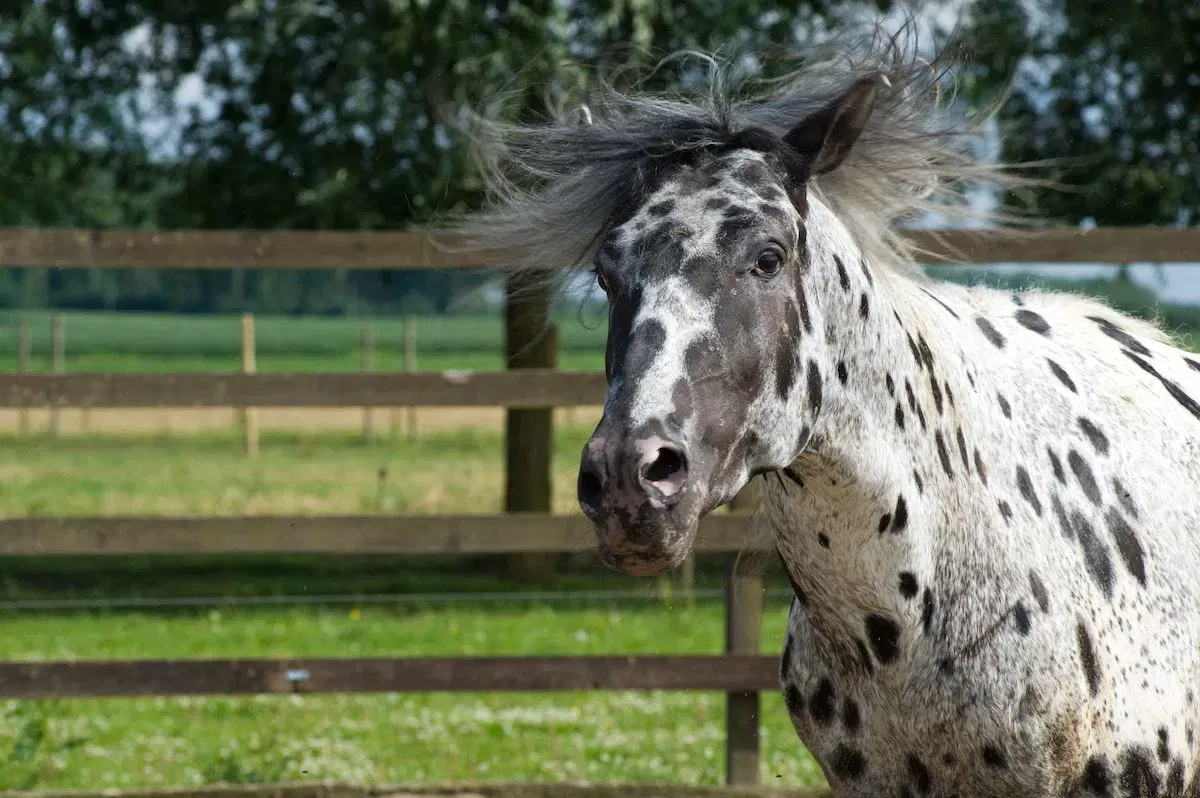
- Reflexive head shaking and snorting
- Playing with the tongue and curling the upper lip (as in flehmen)
- Reaction to light reflections (e.g. contrasts caused by shadows)
- Hypersensitivity to insects and stressful situations
- Rubbing the nose or head on objects and/or on the front legs
- Clear to whitish mucus from the nose, watery eyes
The symptoms usually worsen on warm, sunny days. Affected horses react sensitively to light reflections such as glittering snow and should not be exposed to direct sunlight. Wind can also worsen or ease the discomfort, depending on the horse.
Typical signs include extreme touch sensitivity on the head, frequent rubbing of the nose on objects or the horse's own legs, as well as dragging the nose along the ground. In severe cases, horses strike their head against solid objects, which can indicate severe pain.
Symptoms can already appear when haltering or bridling. Under the rider, the horses often appear uncooperative, easily startled, and unwilling to work, especially under changing light conditions.
Many affected horses lose weight or appear exhausted and tense. Notably, some horses show hardly any symptoms in a clinical setting, which points to a strong connection with housing, environment, and stress.


What are the causes and triggers of headshaking?
Headshaking can occur in horses of all breeds and age groups. Statistically, geldings and horses from around 7 years of age are more frequently affected – whether this is significant remains unclear.
Possible triggers
Health-related causes are not always present. Unsuitable bridlework, bit or saddle, strong rider influence, stress (e.g. from competitions or a change of stable), unsuitable housing or feeding can also trigger headshaking.
Medical causes
A frequently discussed cause is the close contact between the trigeminal nerve and the optic nerve, which can lead to light sensitivity. Nerve damage caused by viruses (e.g. herpes) or bacteria (e.g. Lyme disease) may also be possible triggers.
Due to the wide range of possible causes and interactions, diagnosis remains complex and poses a major challenge for veterinarians and owners alike.
Treatments and Therapy Approaches
Since some headshaking cases occur seasonally, a link to the hormonal balance was suspected. However, a hormone-based vaccination with gonadotropin-releasing hormones showed no success – moreover, the study size was too small for reliable results.
A team from California chose the approach of nerve pathway stimulation purely for the diagnosis of idiopathic headshaking. Using the so-called SEP test (somatosensory evoked potentials), the relevant nerve pathways are stimulated via electrodes using electrical current within a certain frequency range, and the resulting values are recorded and compared with those of unaffected horses. Unfortunately, this test method proved inconclusive.
What was interesting was the discovery that affected >nerves, despite local anesthesiahigh tension. This means that the classic therapy of numbing or anesthesia of the trigeminal nerve is likely to bring only limited success.
Common remedies such as painkillers or non-steroidal anti-inflammatory drugs are usually ineffective. Even neurectomies (surgical or chemical), as recommended by veterinarians, often bring only moderate, non-lasting results and are costly.
❗ "non-steroidal anti-inflammatory drugs" -> are medications that can relieve pain, reduce inflammation, and lower fever – without containing cortisone.
❗ "Neurectomies" -> a medical procedure in which a nerve is severed or removed.
A surgical neurolysis of the trigeminal nerve was intended to relieve pressure on the nerve. A Hanoverian gelding severely affected by headshaking was selected as the test subject. The course after the operation was quite stressful and painful for the horse. In the end, improvement was visible, but after just a few months the headshaking returned. Less than six months later, the horse was put down, as the gelding no longer had an adequate quality of life.
The search for an effective yet also affordable treatment is a long and frustrating process for many horse owners.
Adaptogenic Plants & Herbs Give Hope


The term „adaptogen“ comes from the word adaptation and describes substances that help the body adapt to physical and mental stress. In human medicine, they are used for stress, anxiety, and sleep problems, but they are also known in veterinary medicine.
Ginseng is one of the best-known adaptogens. It has a tonic effect, strengthens the immune system, and supports the body's own defenses.
Adaptogens such as roseroot influence, among other things, the serotonin balance – a so-called „happiness hormone“. This affects general well-being and also regulates the tension of blood vessels.
Different adaptogenic plants are often combined to enhance their effect.
Examples include:
Taiga root is known for its strengthening, stimulating, and immune-boosting effects. In both animals and humans, taking taiga root has been observed to increase performance and concentration.
Roseroot is used for poor concentration, sleep disorders, and mild low mood, as it positively influences endorphin release as well as dopamine and serotonin levels.
Maca root (a root tuber), which originally comes from South America, is known for providing the body with energy and increasing endurance and resilience.
The blend, or a highly concentrated extract, of the adaptogenic plants and herbs mentioned can support horses affected by headshaking and help enhance the quality of life of the animals affected.
Conclusion


Frequently Asked Questions💡
For problems/complaints: 👉 Here we recommend the 6-liter course
At the start, we recommend feeding the increased requirement (3 times the daily dose). Stay on the high dosage until an improvement occurs, plus 2 more days. Then feed 2 times the normal requirement. If the improvement continues, feed the remaining bottles at the normal dosage. How much needs to be fed always depends on the individual problem — that is, whether improvement occurs faster or not.
For prevention: 👉 Here we recommend the 3-liter course
To prevent problems and support general well-being: preventively, meaning no increased requirement, just the normal requirement for at least three weeks.
Not sure if your horse will eat our products? No problem! We offer you our EWALIA Feeding Guarantee.
If your horse doesn't accept our products, you'll get the full purchase price back from us. How does it work and what do you need to keep in mind? Simply send the products back to us within 30 days of purchase and fill out our form with the details of your order, a short, unedited video of your horse, and the proof of purchase.
If you purchased your EWALIA products from a retailer, contact the retailer directly within 30 days of purchase with your proof of purchase and video. They will refund the purchase price immediately. The Feeding Guarantee can be used once per customer on products ordered for the first time. Per order, the guarantee applies to up to two different products.
You can find more information about our Feeding Guarantee here in our terms and conditions: Feeding Guarantee.
1. Better absorption and availability
Herbal liquids contain the active ingredients in dissolved form, which makes absorption in the body easier. They are often better tolerated, especially in animals with sensitive digestion or poor chewing ability (e.g. old horses or dogs).
2. Higher bioavailability
Due to the liquid form, nutrients and secondary plant compounds are absorbed into the blood more quickly, allowing them to take effect faster. Dried herbs must first be broken down in the digestive tract, which takes longer.
3. No dust exposure
Dried herbs can be dusty, which can be especially problematic for sensitive airways (e.g. horses with COPD or dogs with allergies). Herbal liquids are dust-free and therefore also suitable for animals with respiratory conditions.
4. Easier dosing & feeding
Herbal liquids can be mixed into feed more easily or given directly into the mouth. Especially with picky animals, the liquid form can be advantageous, as acceptance is often higher than with bitter-tasting, dried herbs.
5. No impact from inferior feed quality
Some dried herbs lose their active ingredients due to improper storage or contain fungi, mold, or contaminants. High-quality herbal liquids are freshly pressed and gently processed, so the ingredients are largely preserved.
We recommend feeding our product twice daily. This ensures that the body can optimally absorb the valuable herbal active ingredients. One option is to prepare the feed the evening before, for the morning feeding by the stable hand etc., as long as it is administered within 24 hours (especially important in summer). Alternatively, one portion can be fed before and one after the riding session.
If twice-daily feeding is not possible, we recommend administering 80% of the total daily dose to achieve the desired effect. For example, this would be 112 ml once daily for a total daily dose of 140 ml (70 ml + 70 ml). Our experience shows that regular twice-daily feeding is the best option to make full use of our products' effectiveness.
You can find all further questions in our 👉 FAQs
Our products serve as a supportive measure in the form of complementary feed and do not replace veterinary examinations.
Yes, up to 3 liquids can be fed at the same time.