Fecal Water in Horses


- for stable intestinal function
- for optimal digestive processes
- for a healthy intestinal flora
What Is Fecal Water?
Strictly speaking, fecal water is not actually "water", but in most cases a brown mixture of several fluids such as bile fluid, lymph fluid, and much more, which are not absorbed during digestion but instead are carried along or pushed through the intestine until they exit via the anus. The consistency can vary quite a bit, from mucous and viscous to as liquid as water, which can run out of the anus in larger amounts. The amount of fecal water depends on the horse's underlying problem and should therefore be regarded purely as a symptom. It's important to first determine whether it is actually fecal water or diarrhea.
What Is the Difference Between Fecal Water and Diarrhea?
Where Do the Fluids in the Intestine Come From?
Fecal water is a mixture of several fluids, secretions, and mucus, which get into the feed pulp from various areas. Let's take a closer look at fluid intake and removal in the digestive process.
Digestion begins in the head gut, i.e. in the mouth. ... (Zwischenüberschrift: "The mouth and saliva") Here, several salivary glands produce around 40 litres of saliva a day. The chewed feed is mixed with saliva and swallowed. At the end of the oesophagus, it enters the stomach under pressure. Chewing and swallowing already trigger digestive processes such as the formation of enzymes and hormones. These control the further processes in the stomach and intestine, for example the amount of stomach acid and digestive secretions as well as the activation of intestinal peristalsis, i.e. the muscular activity of the intestine.
The stomach acid dissolves easily digestible carbohydrates and initiates protein absorption. The stomach empties every 2 hours. Feedstuffs that swell strongly, such as starch-rich concentrate feed or modern gut-cleansing minerals like bentonite, are quickly pushed into the small intestine and often bind a lot of water. The dry lump of feed can then lead to a sluggish intestine, because the intestinal muscles have to work hard to move it along. In the worst case, this results in intestinal irritation instead of "cleansing".
Once it reaches the small intestine, the food pulp receives further fluids, namely bile from the liver (the horse has no gallbladder) and up to 30 litres of pancreatic secretion per day. Both are responsible for fat breakdown and carbohydrate breakdown and are dependent on each other, since these processes can only start in an alkaline, i.e. non-acidic, environment. Along the entire length of the small intestine (19-30 metres), "mucus" is produced. This makes further transport easier. In addition, the cells of the small intestine are highly permeable to water. All in all, in a 500 kg horse, 125 litres of water flow through the secretions in the digestive process each day before reaching the large intestine. The sodium content also plays an important role in the small intestine. The presence of electrolytes, especially sodium, is considered the driving force of water resorption. A disturbance of the electrolyte balance can therefore also lead to water loss and free fecal water.
The highly effective lymphatic system in the cecum also contributes to the rapid return of water into the intestine, or its resorption back into the metabolic circulation. The actual removal of fluid from the digestive mixture before excretion only takes place in the rear section of the large intestine.
Once it reaches the stomach, the chewed and salivated feed is moved along by contraction of the gastric cells. In the middle (fundus) and at the end (pylorus) of the stomach, the pre-digestion and preparation of the food pulp for the intestine begins. It is important to mention pepsinogen breakdown here. This is a still-inactive enzyme that is "prepared" by stomach acid and converted into pepsin. This pepsin is responsible, in the small intestine, for breaking down the proteins and utilising them.
Conclusion

What Are the Possible Causes of Fecal Water?
You can't assume that fecal water is purely a problem of the large intestine and its absorption capacity. In most cases, it is not a single disease in itself, but a symptom of a digestive system that has fallen out of balance.
Phases such as feed transitions, competition excitement, changing stables, changing herds, or medications can briefly disrupt the digestive process and don't necessarily require a vet's attention. This usually settles back down fairly quickly once the cause of the stress has been resolved. However, if the fecal water persists for longer than 6 weeks, it is recommended to take a closer look at specific areas:
Triggers for free fecal water
Poor dental material, inflammation in the mouth, and misshapen molars are not only the reason for poor feed breakdown and preparation, but can also cause reduced food intake due to pain. In cases of noticeably long-lasting free fecal water, having the mouth examined by an equine dentist is certainly the first step in investigating the cause. If the preparation of the feed in the mouth does not work well and salivation is not sufficiently stimulated, the digestive process is already significantly impaired from the start, which can lead to further problems along the way to utilisation.
A lack of nutrients can also cause free fecal water. Iron deficiency and sodium deficiency have a major influence on water resorption from the small intestine, but a lack of protein can also lead to intestinal irritation if there is not enough protein available to renew the tissue. A well-balanced overall ration, which is of course adapted to the horse's needs, should be reviewed by the horse owner or keeper once or twice a year. A comprehensive blood count can also provide information about acute deficiency situations that have clearly existed for some time, but it does not replace balancing the basic ration. Not every deficiency is immediately visible in a blood count.
The gut flora cannot be precisely defined. There is no single "one" gut flora. Exactly how it is composed depends on what the horse eats, where it lives, how it is kept and how it is exercised or used. The colonisation and pH value of each section of the intestine can look quite different. Even two horses of the same breed in the same stable can show a fundamentally different gut colonisation. A disruption of the flora, i.e. dysbiosis, can have various causes and should be professionally clarified by a clinic or a specialist veterinarian. A precise assessment of the gut colonisation would be a basic requirement for determining why the balance of bacteria, fungi and yeasts has become disrupted here. However, an analysis of the gut would only be considered once all other problem areas have been optimised and clarified.
If you are not the horse keeper yourself, as an animal owner you are often not directly involved in assessing the quality of the forage. So you are dependent on the quality control at the facility where the horse is kept actually working. However, the know-how needed to recognise mouldy bales or those contaminated with too much soil and sand is not always present at the facility. Sometimes the riding students feed, sometimes the boarders themselves, and an unusable bale ends up in the hay rack. It is worth checking at this point what your own horse actually gets to eat. If the hay is noticeably dusty when shaken out, smells musty, looks brown, or even contains clumps of soil, you can assume that quality management in your stable is inadequate. One of the most common causes of long-lasting free fecal water is poor hay quality (mould growth or too many mould bacteria). If the proportion of straw is also significantly increased and exceeds 20% of the daily ration, this can already lead to massive fermentation problems. If haylage or dry silage is fed in your stable, you should also clarify the quality here. Dry silage does not necessarily have to be the main cause of free fecal water. However, if the silage being fed resembles cattle feed, is very wet, has a strong smell, or even shows several white patches, you can assume that it contains a lot of lactic acid bacteria, which have a negative effect on the gut flora. Your horse should not be given that to eat.
Gastritis or a bleeding gastric ulcer can also be a cause of persistent free fecal water. This is especially the case if your horse chews without food in its mouth, yawns or licks frequently, is very sensitive in the girth area or directly on the belly, and tenses up strongly in the sacroiliac area. You can read more on this topic here: Gastric ulcers in horses.
- Hunger due to overly long gaps between feedings
- Stress within the herd
- Stress caused by unsuitable housing conditions
The main cause of digestive problems in horses: stress. The horse feels unwell, overwhelmed, suffers from hunger, cannot settle down, is constantly moving, or perhaps is not allowed to move enough, is in pain, or is even depressed. All of this sooner or later leads to possible hyperacidity and, as a further consequence, to gastritis, a disrupted gut flora, or directly to small intestine inflammation. Chronic stress should be avoided in any case. This can never keep your horse healthy, so it is advisable to observe your horse very closely. It takes time to analyse whether the horse in question visits the hay rack often enough, whether it feels comfortable within the herd, whether it can or is allowed to move sufficiently, whether it gets adequate relaxation time, and so on. This time spent observing is a good investment and spares your horse pain and discomfort, and ultimately saves you a lot of money too.
A well-thought-out deworming management plan should be a basic requirement in every stable, regardless of the type of housing. A fecal sample can already rule out a large proportion of possible parasites. The rest can be checked by means of a blood sample if parasite infestation is suspected. Intestinal damage caused by worms can not only lead to malnutrition, but is also very painful for the animal concerned. Therefore, reviewing the deworming schedule is also a good approach.
What to Do About Persistent Fecal Water?
Here are the most important steps for clarification:
- Look closely at your horse: Does it show signs of pain? Is it severely bloated? Is it colicking? Does it have real diarrhea and not just fecal water? If you notice clear signs of pain, or your horse is colicking or has diarrhea, then call your vet IMMEDIATELY!
- Check your deworming schedule and, if necessary, use a fecal sample to determine whether deworming is needed.
- Check hay or feed quality, if possible over a longer period of time. Stop feeding wet silage immediately.
- Observe your horse in all areas: at the yard, out in the field, in his stable/loose box, on the paddock, in interactions with stable neighbors at different times. Investigate possible sources of stress and try to minimize it (change of stable, change of herd, change of housing type, etc.).
- If it's not due to feed quality, stress, or parasites, have your vet come out to take a look at the organs, inflammation markers, possible nutrient deficiencies, or the gut flora, or refer you to a specialist vet.

What can I feed to help support my horse when feed changes such as turnout cause free faecal water?
Seasonal fecal water mostly occurs in fall and spring, specifically whenever the feed transition for the horse or its gut happens a bit too quickly. If there isn't enough time in the stable for an adequate grazing introduction phase, or if your horse repeatedly has trouble with the transition, you can provide effective support with herbs.
- Marshmallow root (Althaea officinalis): contains a high proportion of mucilage, which has an anti-inflammatory and soothing effect on the stomach and intestinal tract.
- Oak bark: is used in veterinary medicine for diarrheal conditions and has a strong effect on intestinal peristalsis and the intestinal walls. Thanks to the tannins it contains, they contract better again and get a sluggish gut moving again.
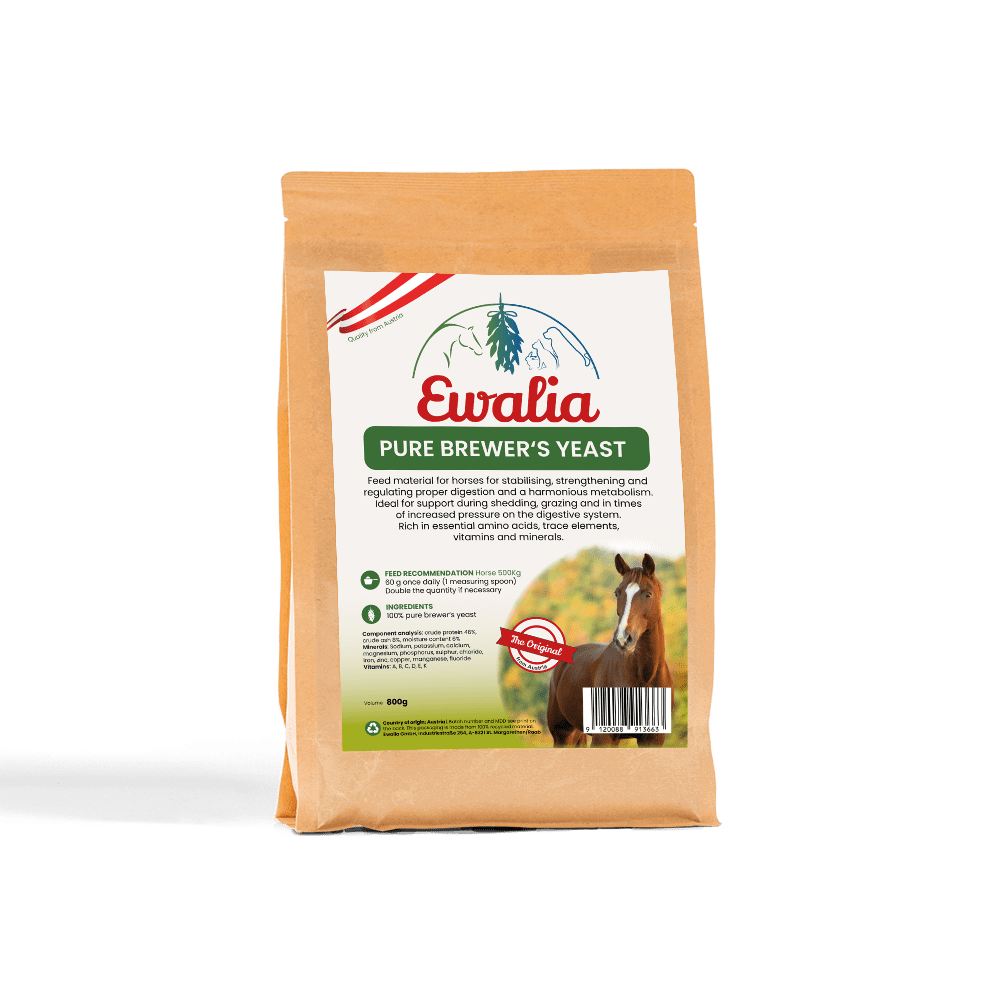
Additionally, you could support your horse in binding the excess water from fresh grass in the stomach by feeding brewer's yeast, ground flaxseed, or psyllium husks. You can start feeding herbs as early as one week before turnout onto pasture. We recommend feeding swelling feed additives like brewer's yeast or psyllium husks only from the first day on the pasture.


Frequently Asked Questions💡
For problems/ailments: 👉 Here we recommend the course with 6 liters
At the start, we recommend feeding the increased amount (3 times the daily dose). Stay on the high dosage until an improvement occurs, plus 2 more days. Then feed 2 times the normal amount. If the improvement continues, feed the remaining bottles at the normal dosage. How much needs to be fed always depends on the individual problem, i.e. whether improvement occurs faster or not.
For prevention: 👉 Here we recommend the course with 3 liters
To prevent problems and support general well-being: preventively, meaning no increased amount, just the normal amount for at least three weeks.
1. Better absorption and availability
Herbal liquids contain the active ingredients in dissolved form, making absorption in the body easier. This is especially beneficial for animals with sensitive digestion or poor chewing ability (e.g. old horses or dogs), who often tolerate them better.
2. Higher bioavailability
Thanks to the liquid form, nutrients and secondary plant compounds are absorbed into the blood more quickly, allowing them to take effect faster. Dried herbs must first be broken down in the digestive tract, which takes longer.
3. No dust exposure
Dried herbs can be dusty, which can be problematic especially for sensitive airways (e.g. horses with COPD or dogs with allergies). Herbal liquids are dust-free and therefore also suitable for animals with respiratory conditions.
4. Easier dosing & feeding
Herbal liquids can be mixed into feed more easily or given directly into the mouth. Especially with picky animals, the liquid form can be advantageous, as acceptance is often higher than with bitter-tasting dried herbs.
5. No burden from inferior feed quality
Some dried herbs lose their active ingredients due to improper storage or contain fungi, mould or contaminants. High-quality herbal liquids are freshly pressed and gently processed, so the ingredients are largely preserved.
Yes, up to 3 liquids can be fed at the same time.
We recommend feeding our product twice a day. This ensures that the organism can optimally absorb the valuable herbal active ingredients. One option is to prepare the feed already in the evening for the morning feeding, e.g. by the stable groom, provided it is given within 24 hours (especially important in summer). Alternatively, one portion can be fed before and one after the riding session.
If feeding twice a day is not possible, we recommend administering 80% of the total daily dose to achieve the desired effect. For example, this would be 112 ml once a day for a total daily dose of 140 ml (70 ml + 70 ml). Our experience shows that regular twice-daily feeding is the best option to make full use of the effectiveness of our products.
You can find all further questions in our 👉 FAQS
Our products serve as a supportive measure in the form of a complementary feed and do not replace veterinary examinations.
Not sure if your horse will eat our products? No problem! We offer you our EWALIA Palatability Guarantee.
If your horse doesn't accept our products, you'll get the full purchase price back from us. How does it work and what do you need to keep in mind? Simply send the products back to us within 30 days of purchase and fill out our form with the details of your order, a short, uncut video of your horse, and the proof of purchase.
If you bought your EWALIA products from a retailer, contact the retailer directly within 30 days of purchase with your proof of purchase and video. They will refund the purchase price to you immediately. The Eating Guarantee can be used once per customer on products ordered for the first time. The guarantee applies to up to two different products per order.
You can find more information about our Eating Guarantee here in our terms and conditions: Eating Guarantee.